Most strategy does not fail because the thinking is wrong.
It fails at the handover. The document arrives into a company that already has a full week, and a plan is the one piece of work with no deadline attached to it. Everything else in the building has a date. Six months later the strategy is a very well organised file.
This is the ordinary outcome, and it is a scheduling problem rather than a people problem. Which is good news, because scheduling problems have fixes, and you can put them in place before you commission anything.
Here is what we would ask, if we were sitting on your side of the table.
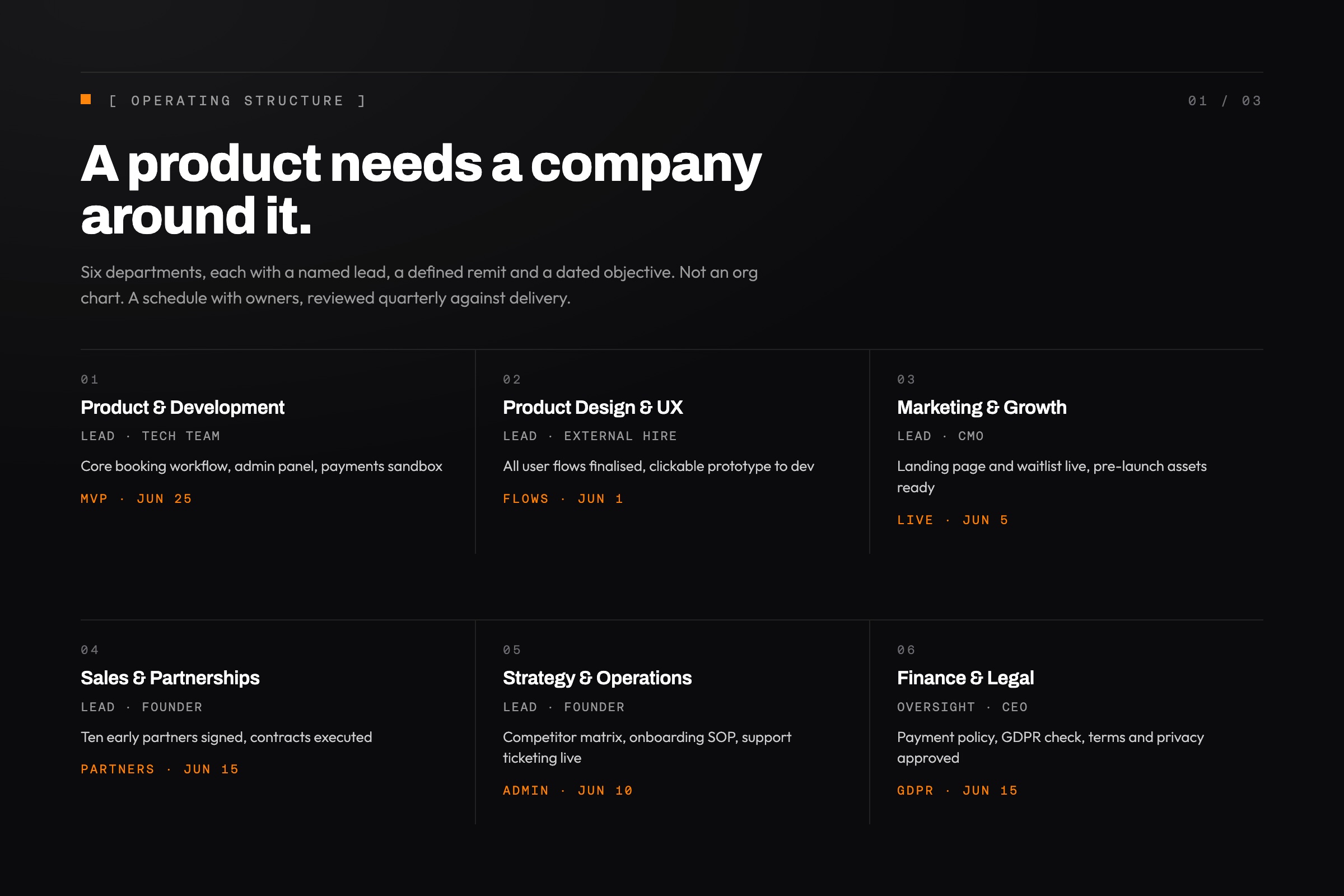
1. Who owns each action, by name?
Not a department. Not "marketing". A person, with a name, who can be asked on a Tuesday how it is going.
An action belongs to whoever will be asked about it. If nobody will be asked, the action is competing for attention against everything that comes with a deadline, and deadlines win.
When we write a phased plan now, every action carries a name. If we cannot find a name for one during the engagement, that is a useful finding in itself: it usually means the company needs a hire before it needs a plan, and it is much cheaper to learn that at this stage.
2. What happens first, and on what date?
If the answer to "when does this start" is a quarter, nothing will happen in that quarter.
Dates create the smallest possible unit of accountability. We work in two-week pieces for exactly this reason: a fortnight is short enough that slipping is visible immediately, and long enough to actually finish something. Twelve months of strategy is really twenty-six chances to notice you have drifted.
3. Is the hard part scheduled before the easy part?
This is the question that predicts the most and gets asked the least.
Every plan contains one thing that makes the business genuinely different, and that thing is almost always the hardest to build. It is also the easiest to postpone, because postponing it is never a single dramatic decision. It is a series of reasonable ones, each defensible on the day, made by people acting in good faith.
The result is a company that ships the familiar half of its idea. It goes to market as a slightly better version of something that already exists, which is usually the exact position the strategy said to avoid.
So: put the differentiator early, and protect it. If it is at the end of the roadmap, it is not really in the roadmap.
4. Who is allowed to say no?
Somebody has to be able to refuse the comfortable work when it crowds out the uncomfortable work.
This matters more than it sounds, because the available work is not all the same shape. Refining the product is inside your control, visible the moment you do it, and always there when you want it. Selling sits outside your control, moves slowly, and gives you very little back on any given Tuesday.
Put those two side by side in a busy week and the first one wins on availability alone. It is not a question of discipline, it is a question of which task is easier to start at four in the afternoon. Every company has this, including ours.
What protects the second kind of work is one person with the standing to say "leave the product this week, we are making the calls." Without that, the calendar decides, and the calendar always prefers the work that is ready to hand.
5. What is the review, and what happens when a phase misses?
Phases only really exist if something happens when one is missed. Otherwise they are headings.
The review does not need to be uncomfortable. It needs to exist, on a date, with someone who has read the numbers beforehand. And it needs one plain question: did the thing we said would happen, happen? A missed phase is information, not a failure. It usually means the plan was optimistic or the resourcing was thin, and either is worth knowing in month two rather than month ten.
The part most people skip
Test the plan against reality early, and cheaply.
Assumptions are the most expensive thing in any strategy document, and they are free to check before you build on them. We write the testing methodology alongside the plan for that reason: numbered scenarios, real devices, real users, a documented finding and a specified fix. It is unglamorous and it repeatedly pays for itself, because a plan that has been tested is a plan you can defend when it gets uncomfortable in month four.
Why we do both halves
We used to be willing to write the thinking and hand it over. It felt clean.
What we learned is that the handover is where the value leaks out, and it leaks for structural reasons rather than human ones. So we would rather build the plan and then be there when the first ten conversations go badly, because the first ten always go badly, and that is precisely the moment a good plan gets quietly set aside.
Strategy that stops at the document is decoration. The useful version comes with someone who is still in the room in month four.