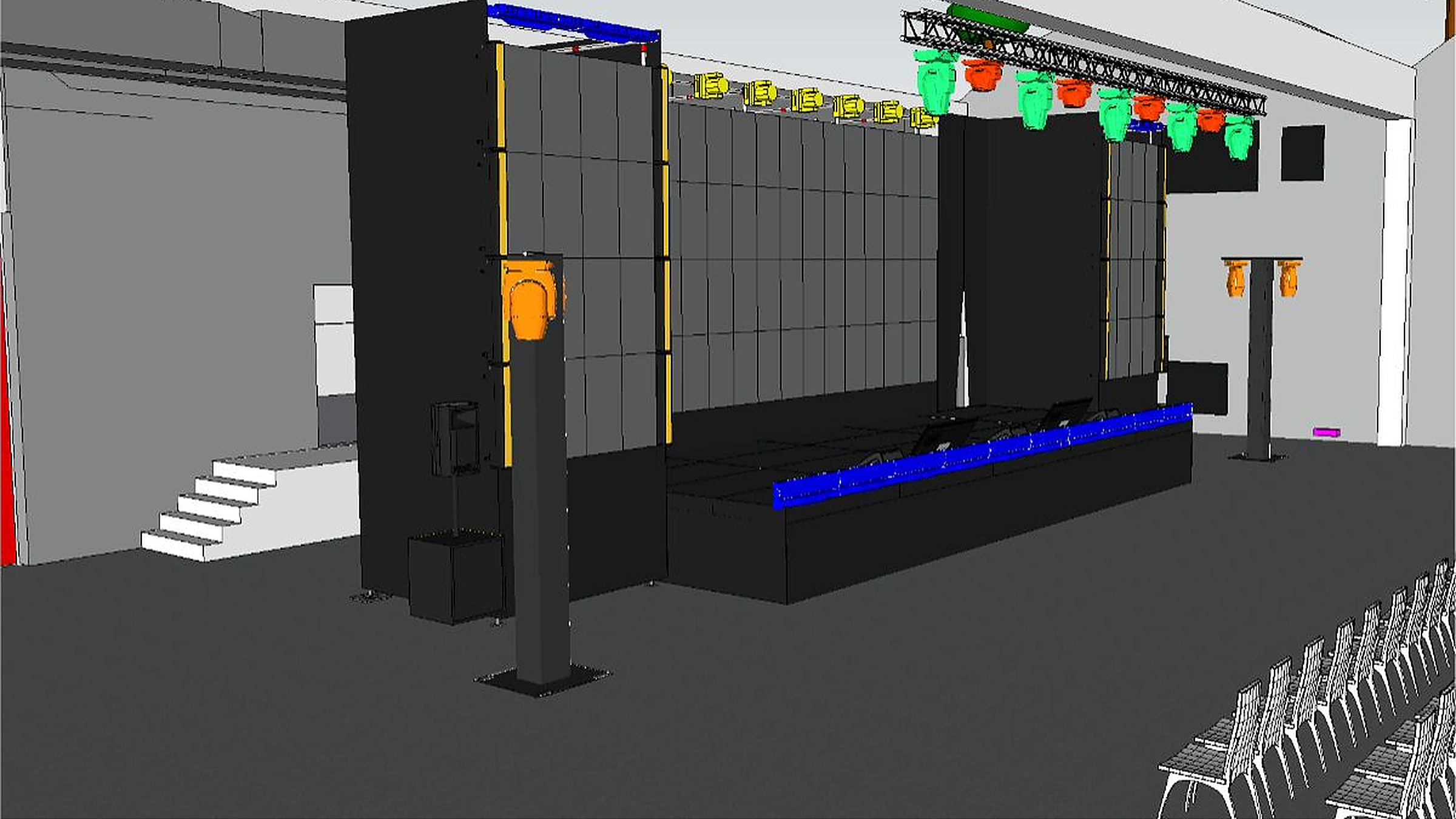
Ten minutes before Exness Week went live between Limassol and Kuala Lumpur, we had no internet. Not a degraded connection. None.
The night before, a cleaner had unplugged the power station feeding the router. It was a plug in a socket, in a room they had been sent to clean, and nobody had told them it was anything else. There is no version of that evening in which they should have known. The batteries carried the load through the night and were flat by morning.
We found it by walking the chain end to end, in order, refusing to skip a link, until we reached a socket with nothing in it. We were back up with two minutes in hand. The show started on time.
That is not a story about a cleaner. It is a story about where the real risk in a live event actually sits, because nothing we owned had failed. No encoder died, no bonded connection dropped, no camera fell over. The event was nearly lost to a completely reasonable act by someone who had no idea what the socket was for, and no brief in the world would have prevented it. You cannot brief a building.
What you can do is build a system that finds a fault faster than the clock runs out. That is the whole discipline, and it is worth understanding what it is protecting.
Because ask most people what a live event failure costs and they will reach for the production budget. It is the wrong number, and it is almost always the smallest one in the room.
The budget is what you spent to make the thing happen. The cost of it going wrong is everything that was riding on the thing happening. Those are different figures by an order of magnitude, and only one of them appears on an invoice.
We have run live production across Cyprus for companies where the second option was not available. A building opening with the client's leadership and their customers in the room. A results announcement going out live to national television. A company conference running simultaneously between Limassol and Kuala Lumpur. In every case the conversation that mattered was not about equipment. It was about what would still be true tomorrow morning if something failed today.
Here is what actually gets spent when it does.
The moment you only get once
Most corporate events are the visible end of something that took months. A results announcement. A building that took two years to finish. A product the team has been building since last summer. A merger nobody could talk about until that morning.
The event is not the achievement. It is the one hour in which the achievement becomes public.
When that hour fails, you do not lose an hour. You lose the announcement. The building still opened, the results are still good, the product still works, but the moment you had chosen to make them land publicly has been spent, and it does not come back. A rescheduled announcement is not the same announcement. Everybody in the room knows why it moved.
This is the cost that no line item captures and the one every executive recognises instantly.
The room you paid for twice
Look at what a mid-sized corporate event costs before production is even quoted. The venue. The catering. The staging. Flights and hotels for speakers. A senior leadership team out of the business for a day, sometimes two. Sponsors who committed on the basis of the audience you promised them.
All of that is spent whether or not the event reaches anyone beyond the room.
So when the stream drops twenty minutes in, the loss is not the streaming line on the budget. It is the proportion of everything else that was justified by reach. If four hundred people were watching remotely and two hundred and fifty of them left, you did not lose a stream. You paid the full cost of the event and delivered a fraction of the audience it was built for.
The maths is uncomfortable in exactly one direction. The cheaper the production line, the larger the share of everything else that depends on it holding.
The year of content that never arrives
A single well-run conference day is the raw material for months of communication. Keynote cutdowns. Speaker clips for social. Session recordings for the people who could not attend. Training material. Sales assets. Recruitment content. A showreel for next year's sponsors.
That entire library depends on decisions made on the day, and the most common way it evaporates is not dramatic. Nobody notices at the time.
Audio taken from the room's PA rather than from the desk sounds acceptable through speakers in a hall. On a recording it is unusable, and no edit recovers it. Slides shot off a screen at the wrong shutter speed flicker on every frame. A single locked camera at the back gives you an hour of one wide shot with no cutaway, which is not an edit, it is a document.
The event still happened. It still felt fine in the room. But the twelve months of material it was supposed to generate does not exist, and the failure is invisible until somebody asks for the highlights three weeks later.
The relationships that were watching
There is a category of viewer who is not your general audience and whose experience you cannot afford to get wrong. Board members dialling in from abroad. The sponsor whose logo was on the frozen slide for six minutes. Regulators. Journalists. The parent company. A prospective client invited to see how you operate.
Those people do not file a complaint. They form a quiet, durable impression about how well your organisation runs, from the only sample of it they were given. That impression costs nothing on the day and shows up later in conversations you never trace back.
Why this lands on the person who signed, not the person who plugged it in
Here is the part that makes this a commercial problem rather than a technical one.
Every consequence above is carried by the business. None of them are carried by whoever supplied the equipment. A vendor who was contracted to provide a stream has met their obligation the moment a stream existed. Whether the announcement landed, whether the sponsors got their audience, whether a year of content came out the other end, none of that is in scope for them, and quite reasonably so. It was never what they were asked to do.
That gap is the actual risk. It opens whenever the people who understand what the event is for are separated from the people responsible for whether it works. The brief passes between them, and the parts that were never anybody's explicit job are the parts that fail.
A socket in a corridor is nobody's explicit job. That is exactly why it is worth checking.
This is why we do not sell live production as a set of boxes with people attached. Strategy leads and production supports, in the same team, because the decision about what happens when a feed dies at minute two is a business decision before it is a technical one. Somebody has to already know which of the four things on that stage actually matters.
What to do with this
Two practical steps, and neither of them is to spend more.
Count the real exposure before you scope the production. Write down what the event is carrying: the announcement, the sponsor commitments, the content you are expecting afterwards, the people watching whose opinion has consequences. That list is the brief. It tells you what has to be true, and everything technical follows from it.
Then check that whoever you hire is accountable for that list, not for the equipment arriving. The technical half of this, the redundancy, the rehearsal, the command structure and the ten questions that separate a real operator from a rental company, is covered in detail in live streams that cannot drop. If you are still at the stage of deciding what you want the event to achieve, start with what to decide before you commission a stream.
We are a strategic and creative operations company working from Limassol, across Cyprus and internationally. When it has to work the first time, that is what we do.